Do you know what your toothpaste costs?
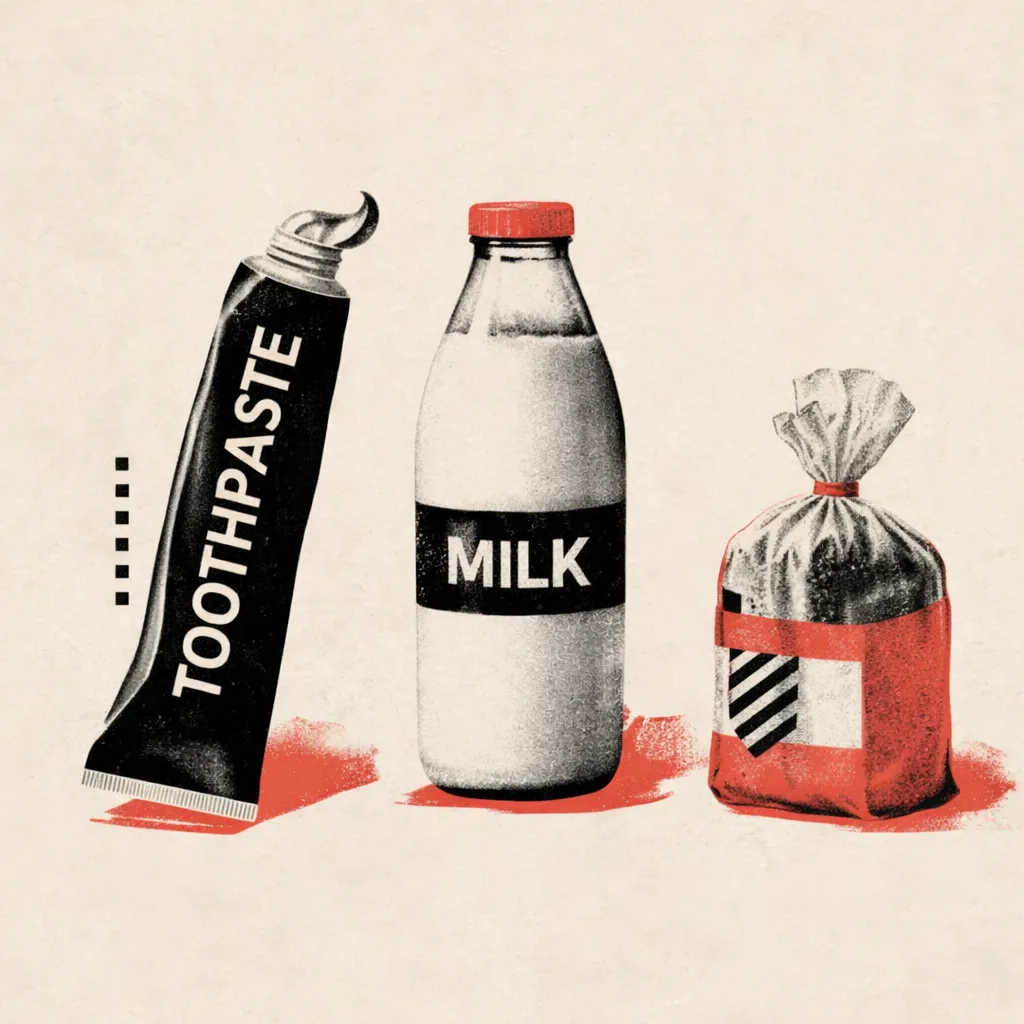
Do you know what your toothpaste costs?
Not roughly. Not "somewhere between ₹100 and ₹200." The actual number. Can you remember it?
I realized today that I can't. There was a Republic Day sale on Zepto, and I went to buy a couple of boxes of my usual toothpaste, and I genuinely couldn't tell if the "sale price" was lower than normal. Or higher. Or exactly the same with a cheerful red tag slapped on it.
I just... don't know what things cost anymore. And that's kind of messed up?
This used to be a rich person problem. The kind of thing that happened when you had so much money that staff and accountants and wealth managers handled the details. Price blindness was a symptom of having enough wealth that someone else could pay attention for you.
But I'm not that rich. I just make decent money, live alone, and order everything through apps. Somewhere along the way, I stopped registering prices entirely. I search "Colgate Total" I tap, I checkout. Done. No comparison. No friction. No moment of "wait, is this reasonable?"
Here's the thing though: I've lost my price memory. Which means I can't call bullshit anymore.
And they know it. (This is the part that gets me.)
Is quick commerce is basically designed to erase your reference points? In a physical store, you'd see the ₹80 toothpaste sitting right next to your ₹180 one (Like Sensodyne or something). You'd have a moment of choice, of comparison. Online, you see exactly what you searched for. Nothing else. The cheaper alternative doesn't even exist in your visual field.
And prices shift constantly now (hourly, daily, per user, per session). There are no persistent price tags. In a store, someone would have to physically change a sticker. Effort. Evidence. A paper trail. On Blinkit, yesterday's price is already gone. You're not comparing against anything real. You're comparing against nothing.
There's no social correction anymore either. At your neighborhood kirana store, some aunty would absolutely say "bhai, yeh toh pehle ₹80 ka tha." There was collective memory. But quick commerce apps have taken that dimension away, and we're all alone with our carts, and no social reference point.
The "sale" has basically become a feeling rather than actual information. Amazon marks up products before big sale days, adds a 20% off sticker, and you get... maybe nothing. Maybe you're paying more than last Tuesday. But you see the red tag, and something in your brain goes "good purchase, good Akash, smart Akash, good boy, well done." It's scary and I feel stupid.
A google search told me that economists call this call this "rational inattention" the sensible decision to not waste mental energy tracking low-stakes information. You're not being dumb by not memorizing toothpaste prices. The cognitive cost of tracking every small purchase would be absurd. It's actually a smart trade-off.
But here's where it got a little scary for me: these platforms are designed to weaponize your rational inattention. Your efficiency is their margin. Every smart decision you make about not sweating the small stuff becomes an opportunity for them to extract a little more. ₹20 here. ₹35 there. Across thousands of users, millions of transactions, it adds up.
A perplexity search helped me find out that behavioral economists call this the "pain of paying" and digital payments are designed to reduce it. One-click checkout. No friction, no pain, no moment of hesitation where you might notice something's off.
I don't have a neat solution here. I'm not going to start maintaining a spreadsheet of toothpaste prices (I mean, imagine). That would be insane.
But I think it's worth noticing. Worth naming. There's a specific trap that exists for our specific moment: enough income to stop paying attention, not enough wealth to have someone pay attention for you, and an entire ecosystem of apps built to exploit exactly that gap.
The price of convenience isn't the delivery fee.
It's forgetting what things are supposed to cost.